30 May 2011

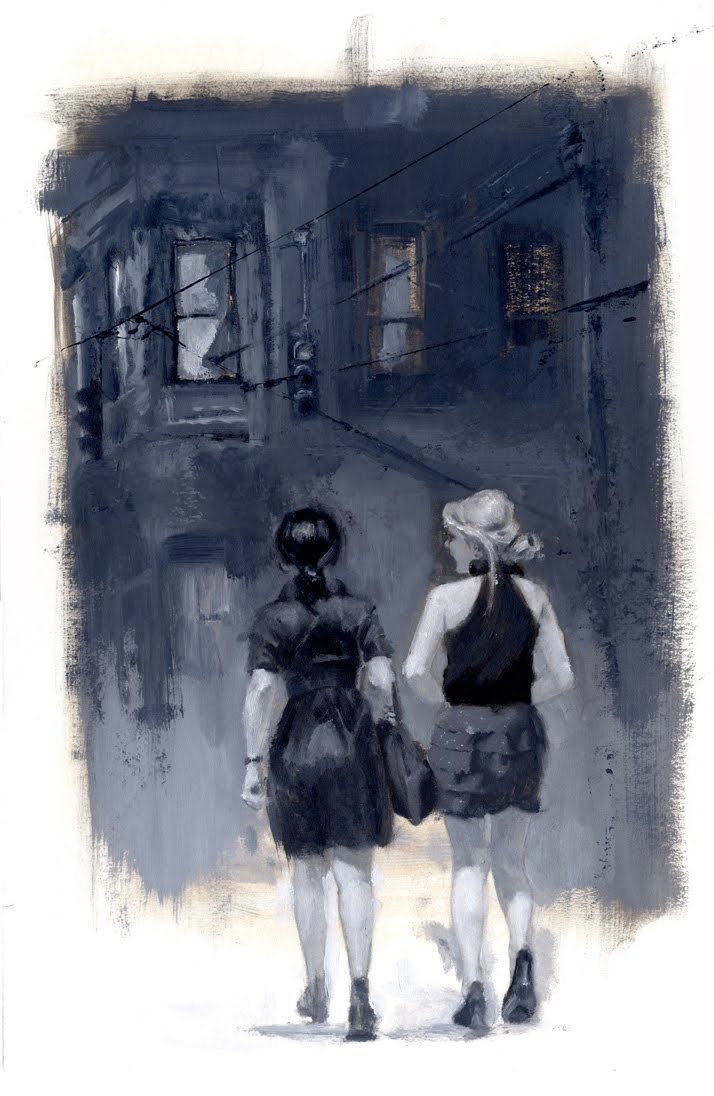
The Past Is Prologue


A reminder for my show opening up this friday. Head over to Robert Lange Studios by clicking here to see the images. All paintings will be posted on my website this Wednesday.

Here's a painting from a series of statues that will be in the show.


The Past Is Prologue, 24" x 15", oil on panel

24 May 2011

Solo Show

American Art Collector feature on my solo exhibition:
Joshua Flint:Invisible Cities


New Paintings will be posted on my website next tuesday and a few more will be posted here towards the build to the show.

Thanks for dropping in.

11 May 2011

Process

Here's a process breakdown of a painting for my upcoming show at Robert Lange Studios in Charleston,SC.
Opening night is June 3rd. Still working on getting the last few pieces completed.


- Quick vine charcoal sketch:


- I pour out shellac over the sketch and smooth it around with a business card or squeegee. It doesn't need to be one perfect layer. The varied drying times in different sections of shellac adds a varied layer of texture and opacity. This stage mimics the traditional layer of glaze one might use with oils without the drying time. The shellac is dry in 10 minutes or less. It also blurs and smudges the charcoal drawing underneath in a spontaneous manner. That sense of spontaneity is exciting and the results can't be totally controlled. I like that.


- Then the oil painting caps off the piece. As with any of my works there are multiple layers of paint built up. That furthering layering of paint also has its own narrative in addition to the subject matter. Sort of a bad photo with this last stage.


As Yet Untitled , Oil, Illustration Board mounted on panel, 15"x10"

I do read the comments when they are left on the blog. I apologize if I haven't thanked those of you for dropping in recently. I always like to hear how others react to my work. So a massive thank you to those who left a message.

02 May 2011

Docs and Pods

If you are like me and need something to listen to in the studio as background noise, while working on your painting, these couple of links could provide just the tonic.

A slew of art documentaries covering all genres and time periods in art history. I'd recommend anything by Simon Schama and also The Art Of The Steal, which is getting press lately as events continue to unfold. You'll know what I mean when you watch the doc. Many more in the list to pique your interest I'm sure. New favorite site.

Streaming Online Art Documentaries

I'm also very interested in hearing about the narrative of an artists life but get bored with critics or writers telling these stories. I want to hear from the artists and get it right from the horses mouth, so to speak. Often these artists were doing representational work in the height of modernism in the 50's and 60's and experienced real rejection by the art world. The Newington-Cropsey Cultural Studies Center was established in 1990 by The Newington-Cropsey Foundation as an interdisciplinary educational resource for art and ideas. It put out this series of podcasts, following the link below.

NCCSC Podcasts
(Be aware that not all podcasts listed after the jump are available in iTunes. So, right click and highlight 'download linked file' to your listen on your CPU or just click the 'listen' link and you will be directed to an online player. Mac users use the option button.)

Although a podcast hasn't been done for a year, there are a nice collection of hour long (roughly) conversations with artists. A few highlights would be Milton Glaser, Burt Silverman and William Bailey who is the Kingman Brewster Professor Emeritus of Art at Yale. Certainly a few luminaries in the representational world of art. Quite frankly I didn't know much about some of these artists but I guess you can never know everything, unless you are Donald Trump.


If you want to hear a 45 minute discussion from the living master that is Antonio Lopez Garcia head over to The American Video Painting Magazine. It may cost a few bucks, $10 exactly, but you get his interview and another hour or so of painting content.

AVPM Downloads


I'll leave you with a new painting for my upcoming June Show at Robert Lange Studios.


Dusk's Gold Filigree, 36"x18", oil on panel.

02 April 2011

Vincent Desiderio Workshop

If you take away something of value from this post it'll have been worth your time, if not I swear I'll post better stuff in the future, so don't desert me if you are left disappointed. Not sure why it got so in-depth but here goes.


I was one of around twenty artists (I think) who received a Regional Artists Project Grant from the United Arts Council for 2011. Since Raleigh, NC is in Wake County that is the branch that awarded my specific grant. At the heart of it they provide funding for an artist to complete a project that benefits his career. It could be for educational purposes, or used to purchase necessary studio equipment, or in a number of other ways. With such a wide scope for a project I would recommend any North Carolina artist to look into the program in your respective county.


My project was of the educational type. I attended a Vincent Desiderio Workshop at the Pennsylvania academy of Fine Art (PAFA) in Philadelphia. He teaches at PAFA, the New York Academy of Art and is represented by Marlborough Gallery. If you don't know Vincent Desiderio's work and enjoy Contemporary Realism there are a few paintings below. If you like what you see I'd encourage you to click on the gallery link. He also has a very nice monograph. when you are looking at the images below just consider that all of his figures are life sized or slightly larger. Scale of idea is very important when viewing his painting. Its as if these characters could walk right out of the scene and into our life.
His large scale triptychs truly epitomize his work, like the one below.

Pantocrator, 82"7/8 x 194" , 2002


Interpretation of Color, 81.2" x 70.3", 1997


Sink, 48" x 64" 1/2, oil on paper, 2010


Being acquainted with his oeuvre and interested in what he had to say about narrative painting in the modern context I booked a train to Philly. I arrived at the oldest art school in the United States just in time for his lecture.


The class centered around realist work in the last 600 years, roughly. With such a wide sweep of history to cover thank goodness Mr Desiderio has an encyclopedic knowledge of the art movements, artists, and philosophies that existed in this time period. Not only did he know dates, names, and titles, he could also summarize large swaths of history. Ultimately, he delivered the information in very definable terms. I received insight into the social milieu of these eras and the constraints faced by many artists. And he cracked many jokes along the way.

Outside of the historical backdrop to the lineage of oil painting in the western world, we also were there to paint. We focused on both direct and indirect painting, which involves the technical narrative and dramatic narrative. Since we were working from models and not developing a personal piece, the dramatic narrative was discussed in relation to realist work in the modern context. That may be a post for another day, so back to the task at hand. I have some familiarity with the indirect method but I normally don't involve glazes in my paintings. I have occasionally used them in the past but not in the last 6-8 years. Certainly not in the manner I'll describe later in this write up.

Much of the philosophy around indirect painting is based on layering opaque paint and transparent glazes to build a painting, where one would go back and forth between the two to achieve the end result. By doing so the painting attains a great depth in the darks. Light will pass through the many layers of glazed color to give off a great effect. At the same time a glaze will obliterate the lit areas forcing the painter to build them anew after each pass. This method allows for an artist to really control how the lit masses will be resolved. This is what has been referred to as the " Mountain Over the Fat." By softening the edges of opaque scumbling into the glaze below, with each successive layer, one can build the 'skin' of a painting, bringing about a tremendous solidity of form. Here's a visual maybe it will make more sense in displaying the notion of blending the transitions of opaque paint into the glaze.


Here are my two studies. The top one follows the indirect painting practice. The second one is much more direct, even though there is a layer of shellac underneath the oil, which is the amber color evident in parts of piece not yet painted.

25'x17"


22"x 15"


The process to set up the indirect painting was as follows:

Using 300lb. hot press watercolor paper I did a quick block in with vine and compress charcoal. At this beginning stage it is a very loose sketch with no details just big masses. Then I spread a layer of shellac over the whole sheet of paper (see pic below). The shellac dries in less than ten minutes as the paper absorbs quickly. At this point I painted the two models thinking mostly about color temperature. In anticipation of the first glaze I was instructed to lighten the value contrast between the shadow and lit areas. This first stage of painting should cover the entire canvas and the paint can be quite thick. As I painted I kept in mind color temperature, edges, and some modeling of the forms but still not getting too caught up in detail or any refined marks. That paint layer dried with the help of Liquin Fine Detail and we applied a burnt umber/ van dyck brown liquin based glaze over the whole image. What you see in my study above is the next and final layer of paint that time allowed. I have completely reworked the models, adjusting the drawing as needed. We only had a few hours so my piece is not developed by any means but it is has the beginnings of a figure which has real weight and 'lives' in its own space on the paper. You might not able to tell with my dodgy photos but in person there is a solidity that can't be attained with direct painting.

The infamous shellac that I used. Sorry about the table it got pretty trashed. Wasn't me.


On the last day we had time to watch Mr. Desiderio revamp another artist's underpainting.


Here are a couple of close ups. Not accustomed to creating a painting with this methodology I really couldn't tell what he was doing for the first half hour. I was sitting there thinking, " well thats not right." However, his color relationships were exquisite and the forms were beginning to slowly emerge. It could have been a reaction to the rich glaze that he was working on and thinking ' how am I going to handle this process.' A short time later, It did come together creating a powerful statement about the figure. His brush marks at first were composed of gentle stabs at the paper, which didn't cover the surface uniformly allowing the rich dark browns of the glaze to shine through. Further on, once enough paint got on the surface,he controlled the entire piece paying closer attention to the transitions, edges and true values of the forms. As more paint was applied and areas were resolved much of the glaze underneath was lost. The shadows maintained thinner paint and the opaque paint was softened into these areas to create the 'skin' of the painting, bring a real sense of weight to the figure. Which refers back to the whole mountain over the fat idea. As you can see from his painting below.


Vincent Desiderio demo study:


He was so animated and lively with his lectures, how could one not be inspired by his enthusiasm. I was enthralled the whole time. Above so many great qualities his openness and honesty in discussing life as a painter was the most memorable. It didn't matter if it was technical, philosophical, professional or personal, he was more than candid about what he knew and really wanted you to fully understand the information. He simply enjoyed discussing what he knew, like an old friend would. This ability to relate his findings and combine it with his own experiences as a painter is evident in his body of work and the nature of his vision. A true scholar and gentleman. He's left an indelible mark on my maturation as a painter. These pics get the brilliant man in full flow.


Lastly, here is a pic of us in the classroom at the end of our workshop. I think it's an apropos image in regards to my outlook as a painter. It's a lifelong journey where we are never too old to learn about our own creativity and where it can take us. This mystery has driven the history of painting.


I've got pages of notes which I am going to compile for my own use and maybe I'll post some more in the future. I'll definitely need to experiment with some of what I learned before coming to any further conclusions. It has prompted me to delve further into the chemistry of oils, its additives, and how I can manipulate the media to best realize my ideas on canvas.
However, right now is not the time, as I am prepping for my own show.

So off to paint and I hope some of you will be that much more inspired today.

09 March 2011

Scooter and such . . .

As with last years show at Robert Lange Studios, I'll be showcasing a number of new urban paintings in color and monochrome palettes. In addition, I'll have a good bunch of gouache and oil studies. The subject matter and approach to the ideas are wildly varying. Here is part of them hangin on a wall in the studio. Not all are quite done. Even with these smaller (8" x 6" each for most) they still require me to get the idea out as best as I can, leave them for awhile, and then follow up with the final elements. A process very similar to a more involved oil painting. Most are done ( in the image below) but there are a few tweaks to some of them until they are ready for display. With all gouache paintings they'll be framed and matted with glass.


Here is a painting recently pulled off the easel, 12" x 12", oil on panel.


Lastly, the horse from the few previous posts needs a couple touch ups and then I'll post the final version.

05 March 2011

Equus, Pt. Deux


24"x15, oil on wood

The main horse is almost fully developed and other horse is getting a bit of work. The background is slowly coming together.
And look, I start painting animals and flowers grow from the easel! Aaaaahhhh, nature finds a way to reclaim everything.
If we only lived in a Pixar world.

04 March 2011

Simplify


I've been playing with how I can frame the figure in an environment and how I want to simplify those visual elements. As with previous work, where I was exploring the movement of figures, here I've used the composition and the flat shapes in the background to impart some movement. Up close the figure is much more broken up with plenty of edges merging into the background, however, from a distance in appears more resolved or refined. That's the feed back I've received so far.


"This Isn't the Whole Story", oil on panel, 24"x12", available at Robert Lange Studios

Have a Friday!

02 March 2011

28 February 2011

growth


'Cluster', 5.5"x5.5", oil on panel.

I've never seen it before moving to the south, growing out of the ground,and had to paint it; cotton.

11 February 2011

Art as Crime

Nothing massive today in terms of painting (albeit there is one at the bottom of the post. What kind of painting blog would this be if it was devoid of painting? Oh, sorry going all existential.)

I want to address a related interest in art of mine and that is art crime. I became fascinated by these nefarious activities when I saw The Thomas Crown Affair. The remake with Pierce Brosnan not the original from the 60's with Steve McQueen. I'm not that old. I thought the movie was intriguing as a kid, upon seeing it recently, I would certainly change my mind. It has its moments but overall less impressed.

However, it planted the seed that people would steal paintings from collectors and museums alike for their own uses, beyond being in love with a painting. I could understand this as it could be a crime of passion. Now, many years after seeing the Thomas Crown Affair, I have read a number of books and seen quite a few documentaries focusing on modern and historic accounts of art crime. Although its been going on for ages perhaps the Nazis looting and caching large quantities of masterpieces during WWII brought it to a world wide audience. Art crime has gone through fluctuations of notoriety since then with The Gardner Museum heist in 1990 and Edvard Munch's The Scream stolen during the 1994 Winter Olympics in Norway.

There are loads of others cases that seem to get neglected by the mainstream media for a whole host off reasons. The neglect of the media to generate mass public disapproval may play a role in why now it has become the third highest crime business in the world behind guns and drugs. Multiple billions of dollars of stolen art are often used in the business transactions of for weapons and narcotics. I'm sure many of you didn't realize that. I know! It blew my mind too. This whole semi long winded stroll down art crime lane was a preamble to me linking a few articles on this very subject. I'm posting these two as they are two I most recently bookmarked. I've deleted a number of these articles in the last year and it struck me that other artists may like to know. Or, at least get in a good short read reminding us of the invaluable nature of art, where some will do whatever they can to acquire it, by whatever means.

A Russian Masterpiece Goes Missing

Also:
What Lucien Freud thinks about his stolen portrait


I will post more links as I come across them. . .do with them what you will. Later in the month I'll put up a couple books on art crime and a few notable links.

Also outdoor still-life action. Another small painting 7"x5":

Visible History

04 February 2011

February 2011 Group Show


This painting is in a group show kicking off tonight at:

The Peterson-Cody Gallery
130 West Palace Ave.
Santa Fe, NM 87501
(505) 820-0010


Click here to go to their website and see all the work

01 February 2011

Men with Swords

Hey February, how did you get here so fast?! I do not know and don't want to ask. Anyways, onward we forge into 2011 and new paintings.

'Men with Swords' could be an apt title to this small set of paintings, but it isn't. They each have their own titles and are tied together in concept and not necessarily in arrangement. The square(middle) one is only 10"x10" with the other two paintings measuring 7"x5".

Changeless Witness


Their size was an important aspect of the initial idea. All of these statues are located in civic or communal spaces. They were made at life-size or over life-size, adding to their significance to their respective cultures. As with many figure-based landmarks their likenesses are often glorified, making them not (entirely) accurate representations of their originator. My concern wasn't necessarily with their individual identities in the first place, it had to do with altering our interaction with the imagery.

Many Lifetimes


By translating them to paint they've become private, personal encounters and no longer exist in a public forum. On top of this notion, the canvas size has stripped them of their monumental scale, creating an intimate experience. This 'forced' intimacy is what I enjoy most about the pieces. When viewing them one can't get around the size and they'll draw the viewer in closer. As opposed to standing back like one would do outdoors with sculpture.


New Courage


Of course, that is more easily experienced in person and not on the web.
Thanks for checking in. . . more soon.

14 January 2011

Oh, Eleven . . .

Well it's the second week of the new year and I am getting back into it. Yeah, it maybe a few weeks into the new year but thats how it goes. I guess if you wanted things on time you'd check the weather updates on your local news channel as they are scheduled every ten minutes.

A few notables to start off 2011.

A little watercolor sketch (below) that was a christmas present for family members. It might have been the only thing I did creatively over my break. The time away was much needed, which is an aspect of living an artistic life that seems to get washed away by the flood of deadlines, by the need to make a living, and by our own compulsion to our craft.


I was contacted by the good people over at Trekell. They are a company in California making quality brushes. After getting a few in the mail, as they don't have retailers throughout the country, I tried them out. I have to say they were very nice to work with and the bristle brushes retained their 'bounce' after multiple uses. They still have a great flex to them a month later.

Although I have been impressed, I'm not here to convince you to run out and buy them. What I will say is that they do work well if you are finding yourself disappointed with your current selection of brushes. They are not paying me anything to say this. It just happens that I have been trying a wide variety of brands looking for a good quality and relatively inexpensive bristle brush. After spending a decent amount of money on brushes over the last couple of years Trekell just hit me at the right time. They also did a nice feature of me on their website this month. There are a few examples of my work and I talk about my crative process. Some of you might find it of interest. At the end I reiterate my opinion on their brushes as described above. Have a look for yourselves and peruse their lines of brushes: Trekell Brushes
Here's a screenshot of their homepage. Check out the image to see what they offer.


I guess that's it for now. So not the most notable but 'postable' perhaps.

13 December 2010

Sketch Give Away Update

Considering my schedule and with the holidays coming up I will am going to delay the sketch giveaway till the beginning of 2011.


Thanks again for all of you following the blog.


Best- Joshua

12 December 2010

Routines

Today on a rainy sunday I've been thinking about routines.
My questions are pretty simple ones. They are based around my desire to do more; always pushing to do more.

What creates the most positive, creative environment?
How do I structure my day to enhance my productivity, and, subsequently, my ideas?

It can be elusive. The notion of putting your creative time into a schedule could be cringing to me and many others. However, at the same time its possible. I've been looking at a great website to discover what many artists have to say about their valuable time and how they manage it. The excerpt below is taken from this site:Daily Routines


Gerhard Richter
He sticks to a strict routine, waking at 6:15 every morning. He makes breakfast for his family, takes Ella to school at 7:20 and is in the studio by 8. At 1 o'clock, he crosses the garden from the studio back to the house. The grass in the garden is uncut. Richter proudly points this out, to show that even it is a matter of his choosing, not by chance. At 1 o'clock, he eats lunch in the dining room, alone. A housekeeper lays out the same meal for him each day: yogurt, tomatoes, bread, olive oil and chamomile tea.

After lunch, Richter returns to his studio to work into the evening. ''I have always been structured,'' he explains. ''What has changed is the proportions. Now it is eight hours of paperwork and one of painting.'' He claims to waste time -- on the house, the garden -- although this is hard to believe. ''I go to the studio every day, but I don't paint every day. I love playing with my architectural models. I love making plans. I could spend my life arranging things. Weeks go by, and I don't paint until finally I can't stand it any longer. I get fed up. I almost don't want to talk about it, because I don't want to become self-conscious about it, but perhaps I create these little crises as a kind of a secret strategy to push myself. It is a danger to wait around for an idea to occur to you. You have to find the idea.'' As he talks, I notice a single drop of paint on the floor beneath one of his abstract pictures, the only thing out of place in the studio.

The New York Times Magazine, January 27, 2002

(Thanks to Dylan Chatain.)

Have a look as it might provide insight for your own needs as a creative. Or just make you feel not so bad that massively well known artists can be as quirky in their approach to art.

Below are a few pages from not my most recent sketchbook but from the one before it. I"ll just note how differently one sketchbook can be to another. Enjoy your Sunday!


Now that my blog followers has hit the 100 mark I will be putting up a sketch that one of you will take home for free.
It's my thank you to all of you. Look for details on monday.

30 November 2010

Works on Paper Show

I'll be displaying a few works on paper in a show opening up this Friday, Dec. 3rd at Adam Cave Fine Art
Headlining the show will be French- based Japanese artist Mikio Watanabe. Mr Watanabe uses a Mezzotint Process. ( Since I have no clue what that is I will direct you to the link to find out.) Regardless of his process the results are stunning especially for being so small. They really draw you in with the scale and force intimacy with each of the pieces.
Here are a few samples of his work.


Mikio Watanabe - Memoire d'eau IV - Printmaking - Mezzotint on Paper - 6" h X 4" w


Mikio Watanabe - S'etendre - Printmaking - Mezzotint on Paper - 3" h X 8" w

Here are three of my four contributions to the group show. I have always wanted to use oil on unprimed illustration board. Contemporary artists and historically significant ones alike have utilized cardboard and other surfaces to get ideas out on. Considering there are many examples of paintings on different types of surface still in existence, I wasn't concerned about the archival nature of oil on illustration board. They should last longer than I will be around that's for sure. How the surface received the oils altered my approach and paint application. It ended be a good change of pace to my other work.
Each image is 15"x10". Two are painted on hot press and two on cold press illustration board.

Blank pages


In Another Time


Signals Overheard

Adam Cave Fine Art
115-1/2 East Hargett Street, 2nd Floor
Raleigh, NC 27601
(919) 838-6692

DECEMBER 3RD: FIRST FRIDAY
WORKS ON PAPER featuring MIKIO WATANABE
Reception from 6-9pm

We are highlighting small works, paintings and prints on paper. Join us for our opening reception this Friday and the debut of our featured artist from Paris, Japanese engraver Mikio Watanabe. Other featured artists include: Joshua Flint, John D. Gall , Susan Baehmann, Matt Lively, Donald Furst, Diana Bloomfield.

26 November 2010


I swear my bulldog is the epitomy of relaxed. . . . she just oozes sleepy time. Very appropriate considering the holidays.

Thank you to everyone who has left comments recently. It's always great to hear your thoughts, insights, and opinions.

If anyone ever has a direct question or comment regarding my work, my process or approach I'll get back to you.